The Tamarack River, Michigan · Spring 1908
The Cook Who Could Read the River
"Scrub the Pots, Old Man," the Foreman's Son Said… Then the River Jam Broke
In front of forty men, the owner's son sent the old cook back to scrub the supper pots and said he couldn't drive a nail into a stump. Then the spring drive jammed at Hollow Rock Falls with a boy pinned under the logs, and the cook was the only man who knew where the key log sat.
- 14:52Runtime
- 1908northern Michigan
- 7Chapters
- FreeOn YouTube
Meet the cast
Who's on the drive
-
The Cook
Eino Lahti 58
A river is a river, and a cook is a cook.
- Strength
- Reads moving water from the bank
- Flaw
- Hides in the kitchen
-
The Boy
Toivo Maki 17
My mother asked you. She never asked me.
- Strength
- Not afraid of the water
- Flaw
- Runs the logs without testing them
-
The Owner's Son
Carter Dorr 19
The old man couldn't drive a nail into a stump. Why do they keep him on?
- Strength
- Quick to go into danger
- Flaw
- Mocks what he does not understand
-
The River Boss
Hap Gallagher 44
Cookie is calling the pull now. We do what he says, and we do it together.
- Strength
- Looks after his men
- Flaw
- Knows the drive but not the Falls
00The history behind it
For the last decades of the 1800s Michigan cut more lumber than any other state, most of it white pine, and the record year was 1889. The work ran on the seasons. Crews cut through the winter and hauled the logs over snow and ice roads to the riverbanks, where they were piled to wait for spring. When the melt came the logs went into the water, and the river carried them down to the mills.
The men who followed the logs downstream were river drivers. They wore boots with steel spikes, called calks, set in the soles to grip wet bark, and they worked with the peavey, a stout lever with a spike and a swinging hook, credited to Joseph Peavey, a Maine blacksmith, in the 1850s. A jam began when logs caught on a rock or a ledge and others piled in behind them. Crews tried to work loose the logs that held the pile, and when that failed they used dynamite. It was dangerous work either way, and men were crushed and drowned at it.
Many of the men were immigrants. Finns began coming to the Upper Peninsula in the 1860s, first to the copper mines, and emigration from Ostrobothnia, on Finland's west coast, ran strong from the 1870s into the new century. The lumber camps took a good share of them, as the mines did. A camp ran on its cookhouse, and a good cook was among the best-paid men in it.
By 1908 the big pine was nearly gone, cut out of Lower Michigan in the 1890s and out of the Upper Peninsula soon after. Drives went on with the timber that was left; the last big one in Michigan ran on the Manistique River in 1929. The Tamarack River, Hollow Rock Falls, the Dorr Lumber Company and everyone in this story are invented.
01The Cookhouse on the Tamarack
Eino Lahti was awake before the lamps were lit in the Tamarack camp. He banked the range, set the bread to rise, and sliced salt pork on the big board while frost still lay white on the cookhouse windows. Outside, the river ran black and quick below the landing, and the first crew men were already stamping their boots on the porch.
Mornings were the hard part for his back. He bent at the waist like a folding rule, and it took a long minute with both hands flat on the table before the old pain let him straighten. The men had long since stopped asking about it. They called him Cookie and meant it kindly, and he had come to like the name well enough.
By six the bunkhouse crew came in stamping and steaming, forty men smelling of wet wool and pine smoke. They took their places down the long benches. At the far end sat Toivo Maki, Matti Maki's son, seventeen years old, with his father's jaw and none of his father's patience, eating fast and watching the door as if it owed him something.
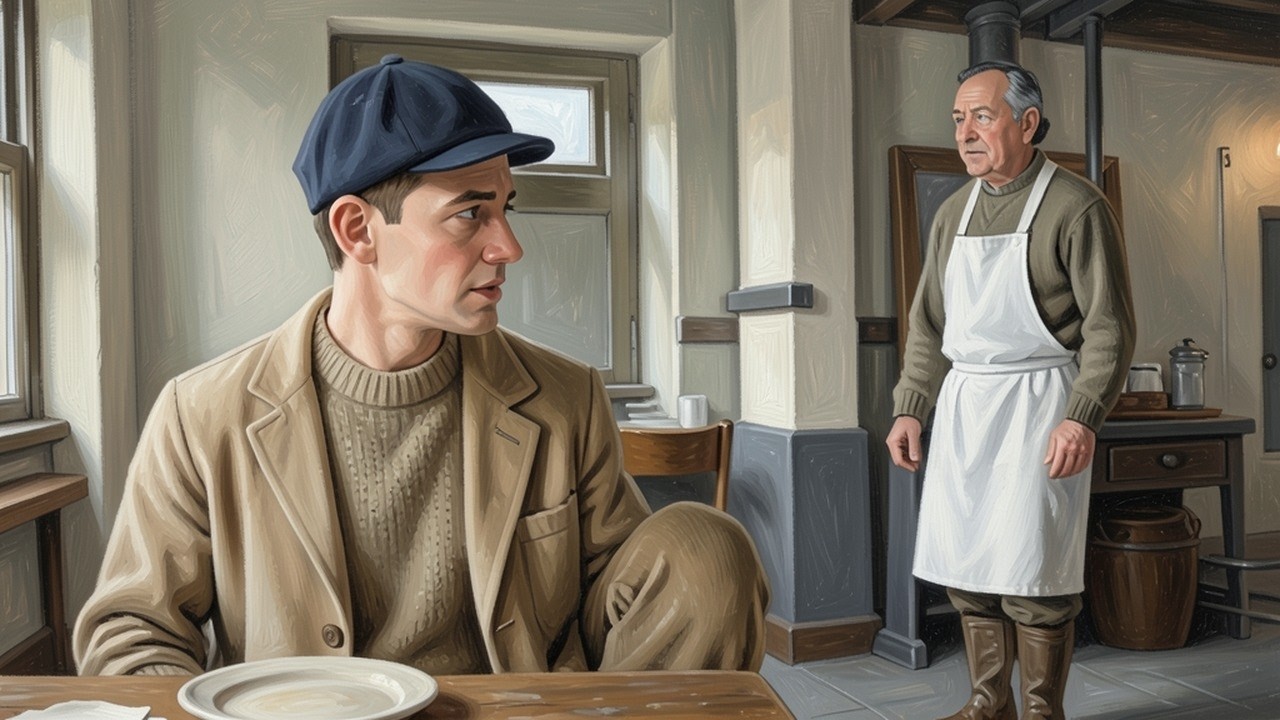
Then Carter Dorr came in with the morning cold on his shoulders. He wore a navy Yale cap, a sweater that had never been wet, and a pair of new calked boots that clacked on the floorboards. He leaned a bright new peavey against the door frame and told the room he had been promised a real man's job on the river this spring.
He sat down across from Toivo and stuck out his boots for the crew to admire. Hap Gallagher, the river boss, said they looked fine for a parade. Carter laughed too loudly and said his father had paid good money for the best calks in Chicago, and that he meant to walk the logs before the first pitch of the drive.
Carter pushed back his plate and looked down the table toward the stove. "Cookie," he called, "you can earn your keep. The pots from supper are still soaking. Go on and scrub them." The men laughed, and Carter raised his voice so the whole bunkhouse could hear. "The old man couldn't drive a nail into a stump," he said. "Why do they keep him on?"
Eino took the pots without a word. He carried them to the wash bench one at a time and set them down in the hot water, and he did not look at the men laughing behind him. Through the window the river slid past the landing, dark and fast, and he watched it while his hands worked the soap. He had not let himself think about the water in a long time.
Toivo came to the wash bench with a towel over his shoulder and began drying the pots. He did not laugh with the others. He asked, low, why Eino never talked about the river, when everyone said he had driven it once. Eino set a clean pot on the rack. "A river is a river," he said, "and a cook is a cook." Then he gave the boy a look that ended the question.
02The River He Left
Eino had driven logs on the Tamarack for twelve springs, from the time he was a boy of nineteen fresh off the boat from Ostrobothnia. A river driver lives on the logs. He learns to run them with his feet, to sleep in wet wool, and to hear the difference between a log that is free and one that is about to roll.
The best of them could read the water. Where the surface went smooth and oily over a dark tongue, a rock lay just under the skin. Where a line of foam crept upstream along the bank, a back-eddy was pulling the wrong way, and a man who stepped into it could be dragged under a log before he knew he was in trouble.
Matti Maki was his partner on the logs. They ran together for eight years, two Finns who spoke their own language in the dark and laughed at each other's English in the light. When Matti laughed, the whole drive turned around to watch him. He had Toivo's jaw and Toivo's quickness, and he never once was afraid of the water.
Sixteen years ago, in the spring Toivo was learning to walk, the jam built up at Hollow Rock Falls against the Anvil, a sunken ledge that broke the river's back. The logs piled high and groaned. Matti went out on the wall to free the key log, and Eino went after him. A rolling timber came down across Eino's back and pinned him to the rock, and he heard the water take Matti before he could see it.
Eino woke in a cot a week later with his spine bent and his legs half numb. Liisa Maki came in with her hands folded over her black dress. She asked him to keep her son off the river, and he gave his word. He had kept it for sixteen years, feeding crews from a cookhouse stove and telling himself a river was no place for a bent man.
The old calked boots hung on a nail in the back of the cookhouse closet now, the leather gone stiff and the calks rusted orange. Eino had not oiled them in sixteen years. He told himself he kept them only because a man should keep his boots. He knew better than that, and he did not take them down.
03The Spring Drive Goes Out
On the first warm morning of May the men pulled the gates at the Tamarack dam. The stored water roared through the sluice and lifted the logs off the flats, and the whole river began to move. Before the crew went out, Eino caught Toivo at the landing. "Ride the cook wagon down to the mill," he said. "Your mother wants you home." The boy shouldered his peavey. "My mother asked you," he said. "She never asked me."
Carter wanted to walk a log before the crew reached the Falls. He stepped out onto a rolling spruce with his new peavey held high, lost his footing on the wet bark, and went under with a shout. Hap Gallagher hooked him by the mackinaw collar with a peavey and hauled him out, spitting river water and red with shame.
Eino had seen it from the cook wagon that morning. A long smooth tongue of water slid over the Falls shelf, where the current should have been breaking white. He knew that tongue. It meant the Anvil lay right under the surface, and a log that caught on it would not come off easily. He climbed down from the seat and went to tell Ansel Dorr what he had seen.
Ansel listened politely, the way a man listens to a cook. "Thank you, Eino," he said. "The water is the water, and the men know it better than we do. Go and see to your bread." Carter stood behind his father with river water still dripping from his cap, and he smirked into his collar.
Hap came to the cook wagon at noon, his red plaid shirt soaked through. "The men are asking me about the Falls, Cookie," he said quietly. "I told them the boss knows best. I'm not so sure I believe it myself." Eino poured him a cup of coffee, and he told Hap to keep the crew on the bank at the Falls, whatever the foreman said, and to listen for the sound of the rock.
That night rain came in from the west, a warm steady drumming on the cookhouse roof. By morning the river had risen two feet. Eino went to Ansel's tent with Hap at his shoulder and said it once more: the smooth tongue, and the rock under it. Ansel did not look up from his ledger. "One more word about the water, Cook, and you walk to the mill." Hap said nothing, but he did not step back either.
04The Jam at Hollow Rock Falls
At Hollow Rock Falls the river narrowed between black ledges and dropped into a roaring chute. The first logs struck the Anvil and stopped. The next ones hit them and piled crosswise. Within an hour a wall of spruce stood across the channel, groaning as the water pushed against it.
Toivo was out on the wall. He had run along the logs to reach the first key timber, quick and proud, the way his father once ran. The stack shifted under him. A heavy spruce rolled off the pile with a sound like a barn coming down, and Toivo went under between two timbers with his leg pinned and the river pouring over his chest.
Carter ran to the edge of the jam with his peavey, shouting for the men to follow him. He got three steps onto the logs before a timber shifted under his new boots and threw him back against the bank. He lay gasping while the water climbed, and one of the jam men caught his arm and dragged him clear.
The jam men stood on the bank and would not go out. Hap Gallagher bellowed for a crew, and the men looked at the wall and at the rising water and did not move. One of them said the whole stack would go if anyone stepped on the key timbers. Nobody argued, because everyone knew it was true.
Out in the chute, Toivo's head came up above the water, and Eino heard him calling in Finnish, short and frightened, the same words Matti had shouted sixteen years before. The water rose another inch. The boy's voice thinned, then rose again, and the men on the bank turned their faces away from it.
Eino came down the bank slowly, one hand on his lower back, and stopped at the edge of the chute. He had not stood this close to the Falls in sixteen years. The Anvil lay under its tongue of smooth water, the back-eddy crept upstream along the left bank, and the pinned boy lay across the key log that held the whole wall together.
Ansel Dorr came down the road with a crate of dynamite on a sled behind two horses. "Blow the key timbers," he said, "and the wall goes apart all at once." Hap Gallagher said the boy would be under the blast. Ansel said the decision was made, and that the river was not going to wait on a cook's opinion.
Eino stepped in front of the crate. He did not raise his voice, but it was the voice that had carried across a cookhouse for thirty years. "Blow that wall and the boy goes with it," he said, "and half the logs go into the bottom of the Falls. Give me the length of one morning. I know where the key log sits." Ansel looked at him for a long moment, and then he looked at the boy.
05The One Key Log
Eino stood at the bank a long while and read the water the way Matti had taught him. The back-eddy along the left shore ran hard upstream, which meant the current under the wall was pulling toward the Anvil. The smooth tongue over the ledge meant the rock was high. Pull one log off the Anvil, and the wall loses its anchor. The weight comes off the boy.
He sent Carter running to the landing for two straight spruce poles. The crew lashed them into a shear-leg on the bank, tops tied, butts set against a stump, with a block hung from the crown. Hap sent his best jam man out over the logs with a messenger line round his waist. The man crawled to the key timber and passed a hitch round its butt, and the manila came back over the logs and up through the block. Carter came back out of breath, his face gone white. "Tell me what to do," he said.
The snub line went round the big cedar stump on the bank, three full turns, so that a line of strong men could hold a thousand pounds of pull by leaning back on the rope. Carter took the first turn himself, around the cedar stump he had once said the cook could not drive a nail into. He said nothing about it. Eino ran the falls through the block and set the men to the rope in pairs, with the slack taken up.
Hap Gallagher understood at once. He had run crews for twenty years and had never once thought to use the bank the way Eino was using it. Hap took his place at the lead of the snub line, and a jam man with a cant hook stepped up beside him, grimacing. "Cookie is calling the pull now," Hap said. "We do what he says, and we do it together."
Ansel Dorr opened his mouth to speak, then shut it. He leaned in, the ledger against his chest, and said, low enough that no one else could hear, that he should have listened on the bank. Eino did not look at him. He was watching the foam. The back-eddy was slackening, so the crest was close, and he raised one hand and began to count the boils.
The water came up the bank in a long brown hump, lifting the logs like a hand under a sack. Eino counted the boils along the ledge, one, two, three, the way Matti used to count them. At the fourth the eddy went still for a single breath. Eino dropped his hand. "Pull," he said, and his voice did not shake at all.
06The Release
The snub line sang as it tightened. The men leaned back until their boots dug furrows in the mud. The shear-leg groaned and bent, the block creaked, and then the key log came up off the Anvil with a crack that echoed off both banks. It rolled free into the back-eddy Eino had read for them.
Without its anchor the wall shivered and slid. The stacked spruce broke apart downstream like kindling, rolling and tumbling into the chute in a long gray roar. The heavy timbers that had pinned the boy lifted, shifted, and rolled clear of his leg, and the river carried them on.
Carter went into the water before anyone could stop him, his navy Yale cap spinning off into the current. He got a rope around his waist and a peavey hooked through the boy's collar, and a jam man wrapped both arms around Carter's belt. Together they hauled Toivo onto a flat log, coughing and blue with cold, his leg bent wrong but his eyes open and furious.
Eino went down on his knees at the edge of the bank. The pain in his back came up hot and white, and for once he did not try to hide it. He spoke to the boy in Finnish, the old words his mother used for children found safe in the snow. Toivo heard him and began to cry. Carter sat down in the mud, shaking, and laughed through his teeth.
07Boss of the Spring Drive
Ansel Dorr came down to the cook wagon that evening with his black Homburg in both hands. He made no speech. He said the company had been wrong about the Falls, and the drive had been wrong about its cook. Then he handed Eino a brass tally marked boss of the spring drive, and said the Tamarack crews would take Eino's word on the water every spring for as long as he drove a log or cooked one.
Carter came up behind his father, bareheaded since the Falls, his hands raw and his new boots scuffed gray. He asked if he could learn the river from Eino, properly, from the bottom up. Ansel looked at his son for a long time before he nodded. "Go downriver with the cook," he said, "and do what he tells you the first time he tells you."
The bunkhouse rang with tin cups that night. The crew came in wet and bruised and crowded the long tables, and somebody banged a cup and called for Cookie. Then the whole room took it up. Eino stood at the door with his hat in his hand and found, to his surprise, that he could stand straight for the length of a song.
Toivo came to the stove later, his leg bandaged and his boots drying by the fire, and asked whether he would ever run the logs again. Eino was quiet a moment, thinking of Liisa's black shawl and Matti's laugh. "Next spring," he said. "You will learn the water first and the Falls last, and you will learn it from me." On Sunday he would climb to the churchyard and tell Liisa her son had come through. The boy grinned the way his father used to.
The Tamarack River, Michigan · Spring 1908
The Cook Who Could Read the River
Watch the full story14:52 · free on YouTube · no sign-up