The Texas Panhandle · The dry summer of 1908
The Windmill Man Who Could Fish the Well
The Rich Man Hired a Drilling Rig… The Windmill Man Fished the Rod Out in Two Days
At the county water hearing, the rancher's son-in-law held up the windmill man's homemade fishing tool and laughed at it, and the board voted for a drilling rig from Amarillo instead. Then the Dunning well's rod parted 280 feet down, with four hundred head dying at a dry tank and the rig three weeks away.
- 15:49Runtime
- 1908the Texas Panhandle
- 6Chapters
- FreeOn YouTube
Meet the cast
Who's at the windmill
-
The Windmill Man
Wade Corley 36
A windmill is a simple machine. It only fails when a man stops listening.
- Strength
- Hears a pump's fault by ear and palm
- Flaw
- Will not explain his own worth
-
The Bookkeeper
Carrie Dunning 28
You'll fish it, and I'll stand on the platform and watch you do it.
- Strength
- Sees a fair bill at a glance
- Flaw
- Never lets anyone see what she carries
-
The Son-in-Law
Lyle Pruett 32
That is the tool of a man who fishes wells with a tin bucket and a prayer.
- Strength
- Can persuade a room
- Flaw
- Mocks a craft he has never tried
-
The Foreman
Tomás Ybarra 50
Scratched a tally on the headgear for every length of rod in the well.
- Strength
- Counts the herd twice
- Flaw
- Says less than he knows
Read it first
The story in 6 chapters
00The history behind it
Water decided everything on the cattle ranches of the Texas Panhandle. Once the open range was fenced, every pasture needed its own water, and ranchers drilled wells and put windmills over them. Windmills began appearing in real numbers in the mid-1880s and spread fast. The XIT Ranch alone had more than three hundred by 1900, with a crew of full-time windmill men to keep them turning. By 1908 factory-built steel mills, from makers such as Chicago's Aermotor, stood over wells across the plains.
A ranch windmill is a pump. The wheel turns in the wind, and the gearing in its head turns that into an up-and-down stroke, carried down the well by a long string of rods joined end to end. Far below, the rods work a plunger in a pump cylinder that lifts water up the pipe and into the stock tank. Every turn of the wheel works the joints, and over the years the wear builds up.
When a rod parted, the wheel ran free and the water stopped. The windmill man pulled the rods that were still attached, length by length, and counting them told him how deep the break lay. Getting the rest out took a fishing tool. Well men kept a whole kit of them for lost tools and broken rods, and an overshot is the kind that slips down over the broken end and grips it, so the piece can be drawn back up.
The other choice was a drilling rig. A cable-tool rig pounded a new hole by lifting and dropping a heavy bit on a cable, a few feet at a time, and a new well could take weeks, which a herd at a dry tank did not have. Dry summers came again and again on the High Plains, and a man who could save a well in days was worth a great deal. Cardwell, its water hearing, the Dunning ranch and everyone in this story are invented.
01The Panhandle Summer
In the summer of 1908 the Texas Panhandle lay under a sky with no clouds in it. The grass was short and grey, the creeks had cracked to bare clay, and on the Dunning ranch a row of steel windmills turned slowly above the one well that still gave water. Their vanes creaked in the wind like old doors. On the High Plains, everyone knew a cattle ranch lives or dies by those wheels.
Wade Corley climbed the windmill tower the way he did every morning, one iron rung at a time, his bad leg taking the weight in short careful pushes. Three years before, a rung had snapped and he had fallen twenty feet into the stock tank. The leg had mended crooked. Nothing in it had stopped him from climbing. He buckled his climbing belt and swung himself onto the platform above the gearbox.
At the top he checked the gearbox by hand, turning the wheel slowly and listening for the grind of worn teeth. He pulled the oil cup and smelled it, then tapped the vane with a wrench and heard the hum that meant the bearings were sound. "A windmill is a simple machine," he would tell anyone who asked. "It only fails when a man stops listening."
Wade kept his tools in a flat wooden box on the wagon bed. There were pump wrenches for the rod couplings, spare leathers for the cylinder, a box of brass valve seats, and a coil of rope with a sounding weight tied to the end. Each handle had a worn place where his hand went. He had forged most of them himself, and they had never once let him down.
In the ranch office, Carrie Dunning sat with the ledger open and her steel-rimmed spectacles pushed up on her forehead. Her father lay ill in the back room, and the books had become hers that spring. She ran her finger down the windmill repairs until she reached Wade Corley's bill and read it twice. It was fair, plainly and exactly, without a line of padding. She had seen a dozen bills that were not.
When Wade came in to be paid, she said the bank would not stretch the note past September. He said he would wait for his money. She told him that was the first sensible thing she had heard from a windmill man in years, and he smiled, a little crooked. He asked after her father. She told him the truth, that the old man was failing. Wade listened the way he listened to a pump.
Out on the flat, Tomás Ybarra rode the herd toward the stock tank at dusk. Four hundred head came slowly across the dry grass, ribs showing under the hide, lowing softly at the smell of water. Tomás had ridden this range twenty years and had never seen the herd come in so thin. He counted them through the gate twice, and both times the number came out the same, and both times he frowned.
02The Water Hearing
The Cattlemen's Association held its summer water hearing in the upstairs room of the Cardwell county courthouse, under a tall window and a county map of the Panhandle. Men in good wool suits sat along the hard benches with their hats on their knees. The water committee was to hear the drought report, and the report was not good. Wade had been asked to bring his tools and show the board what a well repair cost.
Lyle Pruett stood at the head of the green baize table in a cream linen suit, a gold chain across his waistcoat and a cigar case in his breast pocket. He had come up from Fort Worth three years before and married into the Dunning family. He sat on the board, and he liked people to see him there. He simply believed a thing done by a man with a degree was better done.
Joanna Pruett sat on the gallery bench in a pale blue dress, her gloves folded in her lap, where she could watch her husband's face. She was Carrie's older sister, and she had been quietly unhappy with her husband's pride for a year. When Carrie came up the courthouse stairs with Wade behind her, Joanna's eyes went to Carrie's face first, and then to the bundle Wade carried wrapped in sacking.
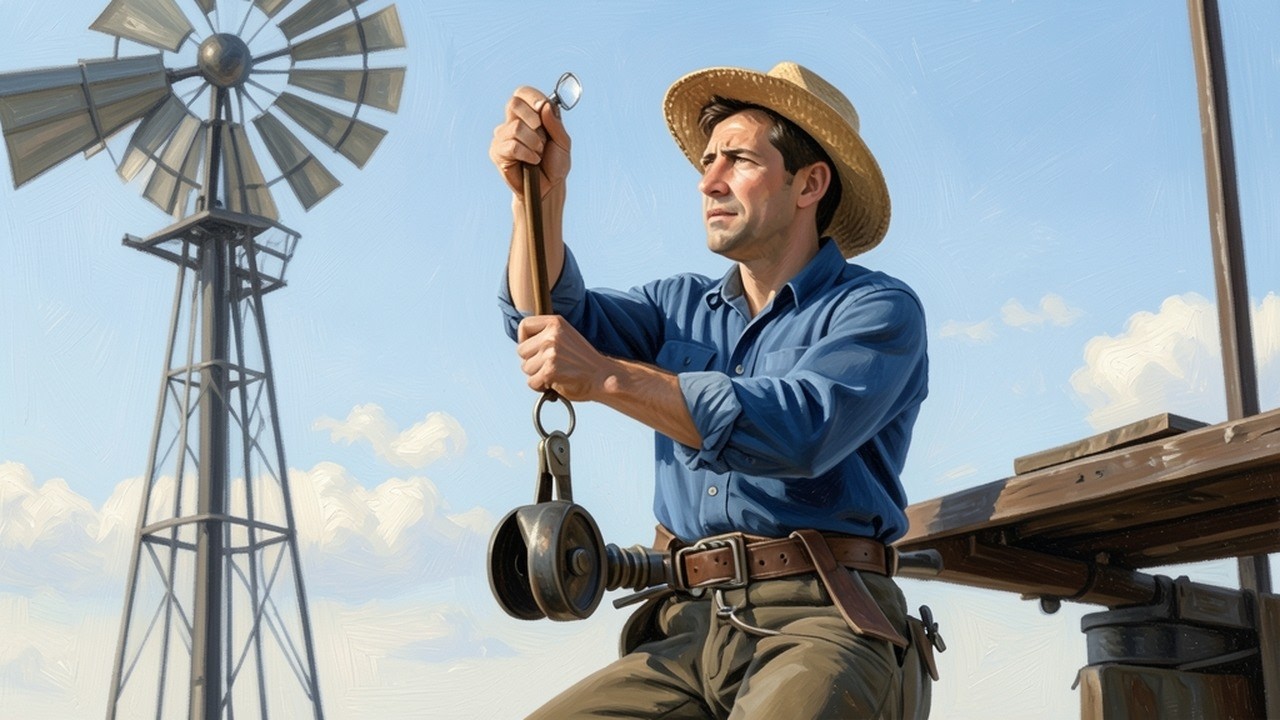
Wade unwrapped the bundle and laid it on the green baize between the inkwell and the county map. It was an overshot, a fishing tool for wells: a cage of forged iron with a spring-loaded grip inside, made from an old wagon axle he had cut and drawn out in his own forge. The board leaned in to look. Nobody at the table had ever seen one made by hand.
Pruett lifted the overshot with two fingers, as if it might soil his cuff, and turned it in the window light. "That," he said, with a smile around the room, "is the tool of a man who fishes wells with a tin bucket and a prayer." Enough of the room laughed. He moved that the Dunning well go to a drilling rig from Amarillo. The rig would take three weeks and cost two thousand dollars, and the board carried it by a show of hands.
Wade did not argue. He wrapped the overshot back in its sacking, tucked it under one arm, and walked out of the hearing room with his limp showing more than it had all summer. Nobody stopped him. In the gallery, Joanna's gloves had gone still in her lap. She looked at her husband for a long moment, and then she looked away from him, and did not look back.
Carrie stayed to the end of the hearing, because a Dunning did not walk out of the Association. She signed the committee's order for the rig with a steady hand. Then she closed the ledger and drove the buggy home across the dark flat. By the time she reached the windmill row she had decided to pay Wade Corley out of her own account, and to hire him before the rig ever left Amarillo.
03The Rod Parts
Two nights later the Dunning windmill began to knock wrong. The pump rod rose and fell with a flat, hollow thud where it should have rung. Then the knock stopped, and the wheel spun free above the tower with no water coming up. Tomás heard it from the bunkhouse and came out in his nightshirt with a lantern. The wheel turned in the dark as if it had forgotten its job.
By sunrise the stock tank was dropping an inch an hour. Tomás climbed the tower with a rope and a lamp and looked down the well pipe with his face against the cold steel. The sucker rod had parted. Somewhere down in the dark, more than two hundred feet below the platform, the broken string hung loose.
The four hundred head crowded the tank at midday, bawling and shoving at the trough's edge, but the water had shrunk to a muddy puddle. The weakest animals went down on their knees in the dust and did not get up. Tomás sent his riders out to move the herd, and he sat his horse in the heat, knowing the number would not stay four hundred for long.
Carrie wrote the telegram at the ranch-house desk with the window open to the heat. She asked for Wade Corley at the Cardwell livery, and signed it with her own name. Dunning windmill rod parted two hundred eighty feet. Herd dying. Come now, and bring the overshot. She read it over once, then sent Tomás galloping to town with it.
Wade came out in the late afternoon with the wagon and the wrapped overshot in the bed, his crooked leg stiff from the ride. Carrie met him at the tower with the ledger under her arm. She told him what the rig would cost and how long it would take, and that the committee had already voted for it. Wade listened without expression. Then he asked how many feet of rod were in the well.
Wade counted the rod lengths from the tally marks Tomás had scratched on the headgear, twenty-five feet to each length: eleven full lengths, and a five-foot pony sub threaded in below the last one. Then he laid his hand on the polished rod and read its stretch. Under the water's load the string always stretched a little, like a rope. When the pump went light on the stroke, the rod had gone slack in the same breath. The break was in the pony sub, just below the coupling under the eleventh length, near two hundred and eighty feet.
Carrie wrote a draft on the Cardwell bank for Wade's fee, the day rate and the tool money. She signed it in front of him and tore it out with a sharp snap, a draft that would never be cashed. The money would come out of her own account, not the committee's. "You'll fish it," she said, "and I'll stand on the platform and watch you do it." Wade looked at the draft, then at her. He said a rig was a good idea for a well that had truly gone dry. He said this one had not.
04Fishing the Rod
That night Wade lit the small forge he carried in the wagon and drew out the spare axle he had hauled for two years. He heated the iron to a dull orange and hammered it into a cage, open at the bottom, with four curved fingers that would close around the collar of a rod. The hammer rang out over the dry yard. Carrie held the lamp and did not look away from the work.
The grip was the hard part. Wade fitted a spring of tempered steel inside the cage, bent so the fingers would open to let the collar slide in and snap shut when the rod was pulled. He tested it on a length of spare rod, dropping the cage onto the collar again and again until the fingers closed clean every time. Each failure taught him something about the angle, and he wrote each one down.
At first light he lowered the sounding weight down the well pipe, letting it drop a length at a time while Carrie counted with him out loud. When the weight struck the top of the broken string, the rope went slack in his fingers. He marked the rope at the headgear, drew it up, and measured it against the tally marks. Two hundred and eighty feet, near enough. Carrie wrote it in the ledger.
He lowered the overshot on the tubing, joint by joint, the iron cage swinging a little in the dark shaft. Each joint went on with a turn of the wrench and a click of the coupling. Wade kept one hand on the tubing the whole way down. A string of tubing that rang clean was empty. A string that rang dull was catching on something. Tomás held the tackle and watched his hands.
The cage reached the broken string and settled over the rod with a dull bump. Wade felt for the collar and worked the tool down over it. He drew the string up a quarter-inch, and the grip slid off the collar and fell back into the dark. Nobody spoke. He pulled the tool up, checked the spring, and set it again without a word. Carrie put a hand on the platform rail to steady herself.
That night the two of them sat on the tower step with a lamp between them. Carrie asked why Pruett had called him a tin-bucket man. Wade said it was an old joke. She asked again. He told her about his father, who kept a windmill row in Oklahoma and taught him to listen to a gearbox before he touched a hammer. Carrie was quiet. Then she said her father had taught her the books the same way.
The night was too dark to work, and the rod was still two hundred and eighty feet down. Wade stretched out on a blanket at the foot of the tower with his bad leg propped on a saddle. Carrie brought him coffee in a tin cup. Before she went to the house, she set the lamp on the step so he could see the cage when morning came.
05One Stroke at a Time
At dawn the cage went down again, joint by joint, with Tomás and two riders on the tackle. Wade lowered it slowly the last thirty feet, feeling the tubing with his palm. When the cage reached the broken collar, he let it rest there for the length of three breaths. Then he drew the tubing up a half-turn at a time and felt the spring take the weight.
The tubing gave a small tug in his hand, like a fish taking bait. Wade held his breath. The fingers had closed. He felt the weight of the rod settle onto the cage, heavier than the empty tubing and lighter than it should have been, and he knew the grip had found the collar. He said one word, quietly, and Carrie heard it across the platform. "Hold," he said.
They lifted the rod one stroke at a time. Each time the wheel came round, Wade drew the tubing up a single joint and set the coupling. The rod came out of the dark a length at a time, twenty-five feet each, the joints gleaming with well water. Eleven lengths and the pony sub. Nobody cheered. Each joint was laid on the planks, and the stack grew beside the tower.
Tomás worked the tackle with his shoulders set and his hat pushed back. He called each stroke in Spanish under his breath, and the riders answered him. This was slow, heavy work, with no room for a man to rush. Carrie stood at the platform rail with the ledger closed on her arm and watched the stack of rods climb past the gear.
The last joint came up a little past noon. Wade turned the broken end to the light and studied it. The rod had parted clean across the thread, with a smooth grey face where the iron had worn thin under years of stroke and stretch. It was a fatigue break, he told Carrie. The rod had been tired a long time, and today it finally gave. Nothing in the well had been careless. It had simply been used honestly.
Wade set the new rod within the hour, and the cylinder took up its work. At the first knock of the pump, water came up the tubing in a dark gush, then ran clear and steady from the spout into the trough. The cattle heard it and came at a run, bawling and shoving. Carrie laughed out loud for the first time all summer, and she did not care who heard her.
06The Water Committee
The Association met again in the courthouse that autumn, in the same upstairs room under the same county map. Wade Corley came in late in a clean work shirt, and he did not change his boots. There was still grease in the creases of his knuckles from the rod. The room went quiet when he crossed it, the way it does for a man who has done a job everyone else only talked about.
Carrie stood at the head of the green baize table with the ledger open and read the figures aloud in her clear voice: the rod fishing, the overshot cage, the spring steel, the day rate, and the three weeks the rig would have taken. The rig had been cancelled. The committee voted to pay Wade Corley's bill in full, and to repay Carrie the money she had advanced him from her own account.
Lyle Pruett did not stand up. He sat with his cream lapels folded, looking at the baize. Joanna sat beside him on the bench with her hand on his arm, and for once she did not move it away. The chairman cleared his throat and said the committee would name another member for the water seat, one who had walked the wells and not merely voted on them. Pruett said nothing. He would remember that silence for the rest of his life.
The chairman asked Wade whether he had anything to add. He shook his head, then reached down for the wrapped bundle at his feet and laid the overshot on the green baize, in the same place it had lain before, with the broken end of the rod beside it, its grey fatigue face turned up to the room. He hung a sack of meal from a length of spare rod on the courthouse hook and set a pencil mark on the rod against the hook plate. When the load came on, the mark sank a hair's width. When he lifted the sack, the mark rose back. "A windmill man reads a well," he said, "the way a doctor reads a pulse. The rod was never lost to bad luck. It went where the wear had been building for years, and I only had to listen for it." He sat down. One man looked at his own boots.
After the hearing Carrie drove the buggy out to the windmill row in the cool autumn dusk, and Wade rode alongside on his bay horse with his bad leg stretched out in the stirrup. The herd was watering at the tank, and the windmills turned above them, steady and quiet. At the top of the rise Wade pulled up. Carrie stopped the buggy beside him. Neither of them said much. They did not need to.
That winter the Dunning windmill row was overhauled from foot to vane, with Wade's tool box in the Dunning barn and Carrie's ledger on the desk. People in Cardwell still tell how the overshot came up from two hundred eighty feet, one stroke at a time, with a Dunning daughter holding the lamp.
The Texas Panhandle · The dry summer of 1908
The Windmill Man Who Could Fish the Well
Watch the full story15:49 · free on YouTube · no sign-up